
 Download the original plan (PDF, Danish)
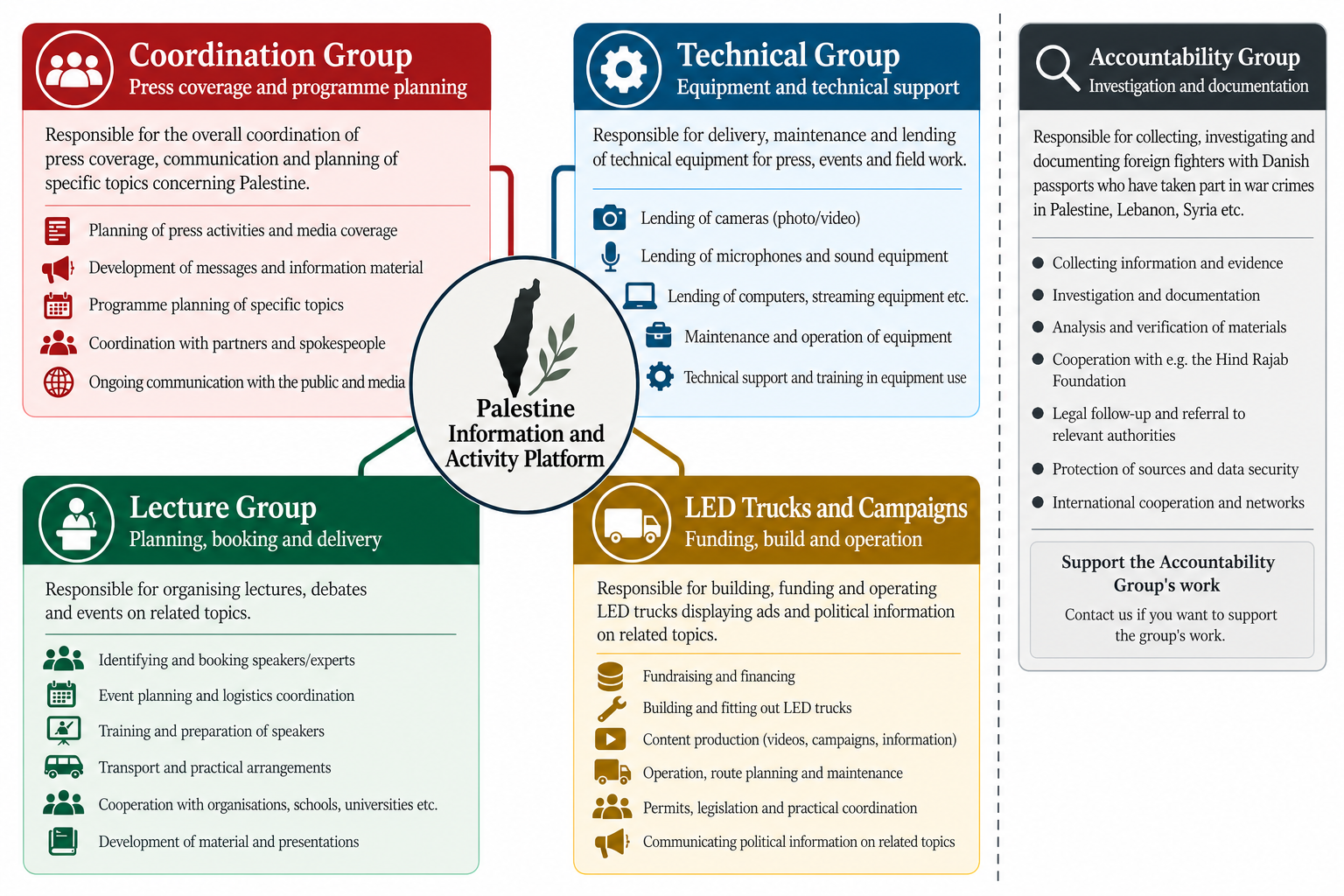
Palestine Information and Activity Platform
Purpose and principles
The plan describes four operational groups and a separate Accountability group. Each group has clearly defined areas of responsibility, tasks, qualification requirements and procedures for start-up and operation.
The organisation must be able to start on a small scale and expand gradually according to need and funding. Staffing figures for the four operational groups are planning estimates; the Accountability group's staffing is determined separately according to mandate, workload and required expertise.
Organisational model
| Group | Area |
|---|---|
| Coordination group | Press, communication and programme planning |
| Technical group | Equipment, production and technical support |
| Lecture group | Booking, events, training and transport |
| LED trucks and campaigns | Funding, build-up, content and operation |
| Accountability group | Separate, non-public unit with confidential working procedures |
1. Coordination group – press and communication
Start-up tasks
Prepare an editorial calendar and plan for topics concerning Palestine, Lebanon, Syria, the environment and other related countries and topics.
Establish contact lists of media, experts and partners.
Introduce a procedure for fact-checking and approval of communication.
Coordinate information activities with the other groups.
Goal: An independent press and information function with regular output and documented quality assurance.
2. Technical group – equipment and production
Minimum staffing: 2 people.
| Role | Tasks and qualifications |
|---|---|
| Technical lead | Equipment catalogue, purchasing, maintenance, insurance and lending procedures. Experience with AV equipment and technical administration. |
| AV technician | Cameras, microphones, sound, lighting, streaming, set-up and troubleshooting. Practical experience in media production. |
Start-up tasks
Establish a digital equipment register, booking system and loan receipts.
Develop routines for inspection, return and maintenance.
Ensure secure file transfer and storage of recordings.
Goal: A well-functioning technical service point with fixed procedures for reservation, lending and return.
3. Lecture group – events and training
Minimum staffing: 2 people.
| Role | Tasks and qualifications |
|---|---|
| Events lead | Programme development, expert contacts, budget and quality assurance. Experience with events and public outreach. |
| Booking and logistics coordinator | Booking, venues, transport, travel and participant registration. Strong organisational skills. |
Start-up tasks
Create a catalogue of talks and relevant experts.
Establish a booking procedure and standard agreements.
Prepare budget templates and training plans for speakers.
Plan transport, venues and the practical running of events.
Goal: To deliver talks, debates and events from planning to evaluation.
4. LED trucks and campaigns
Minimum staffing: 3 people per active truck.
| Role | Tasks and qualifications |
|---|---|
| Project and operations lead | Funding, supplier management, budgets, insurance and contact with authorities. Experience with technical projects and financial management. |
| LED and media technician | Screen configuration, video playback, technical troubleshooting and digital signage. Practical experience with LED systems. |
| Driver / operator | Transport, set-up, vehicle checks and daily operation. Relevant driving licence and training on the vehicle. |
Start-up tasks
Prepare a funding and operating budget and obtain supplier quotes.
Clarify permits, insurance and rules for mobile advertising.
Develop information campaigns and a production plan.
Establish routines for maintenance and safe operation.
Alternative solutions for launching the LED truck project are being explored in parallel.
Goal: One or more legally approved, insured and operational LED trucks with documented operating procedures.
Funding strategies
A three-part funding strategy is pursued in parallel. Donations are the most direct route to start-up, but are supplemented by exploring alternative models:
1. Donations – Fundraising to finance establishment, operation and campaigns.
2. Third party or entrepreneur – Exploring a possible external entrepreneur or other third party who could help establish the project.
3. Business partner or investor – Examining a scaled LED advertising business on ordinary commercial terms with a passive financial partner. Any interest or agreed return for the partner is fixed in advance. The organisation gets free access to the advertising space, in line with the principle of lending equipment.
✓ Business plan prepared. Quotes and technical documentation obtained from a Chinese and an American supplier, with whom substantive negotiations on volume, price and warranty terms are under way.
Principle: After operating costs and any pre-agreed payments to the financial partner, any remaining surplus from the LED trucks' advertising revenue is to be distributed to charity.
5. Accountability group – separate, non-public unit
Organisational principle: The group is separate from the four publicly operating groups. It has its own leadership, restricted access and confidential procedures. No fixed headcount is given; staffing is determined by mandate, workload, required expertise and confidentiality requirements.
The purpose is to collect, analyse, verify and preserve documentation of possible international crimes, including war crimes in Palestine, Lebanon, Syria and other relevant conflict areas involving Danish citizens. The group can prepare documentation packages for competent authorities and relevant international partners, possibly including the Hind Rajab Foundation.
Internal roles and qualification requirements
| Role | Tasks | Qualifications |
|---|---|---|
| Accountability lead | Case prioritisation, internal control, cooperation and overall responsibility. | Experience with legal investigations, human rights or documentation work. |
| Legal analyst | Analysis of possible violations of law, responsibility and legal relevance. | Legal education, preferably with experience in international criminal law or international law. |
| Documentation analyst | Research, source criticism, verification and systematic preservation of material. | Experience with OSINT, digital verification and verifiable research. |
In addition, the group has access to specialist expertise in digital forensics, information security, intelligence strategy, translation and international law as needed.
Areas of work
Collection of lawfully available information and relevant documentation.
Verification of sources, times, places and the origin of material.
Systematic registration and preservation of documentation.
Legal assessment and preparation of material for competent authorities.
Cooperation with relevant legal organisations, possibly including the Hind Rajab Foundation.
Secure handling of confidential information and protection of sources.
Preventing and stopping Danes from taking part in Israeli war crimes.
Confidentiality and internal governance
Need-to-know access: Only authorised persons get access to specific cases.
Confidential working procedures: Internal methods, case overviews and security measures are not published.
Documented chain of custody: The origin of material, changes and access are recorded.
Legal control: Collection, processing and disclosure follow applicable law.
Internal accountability: Oversight of legality, finances and quality without publishing sensitive case information.
First 90 days
| Period | Focus | Deliverable |
|---|---|---|
| Days 1–30 ✓ | Establishment | Mandate, leadership responsibility, confidentiality agreements, case criteria, lawful basis for processing and secure storage. |
| Days 31–60 ✓ | Documentation system | Case register, source control, chain of custody, legal quality assurance and relevant partner contacts. |
| Days 61–90 ✓ | Controlled pilot | Testing of the documentation process, internal quality control and secure handover to relevant authorities. |
Goal: An independent and confidential function able to deliver verifiable material for legal assessment and possible handling by authorities.
6. Shared governance and resource allocation
The four operational groups can share financial administration, volunteer coordination, purchasing, booking, shared premises and general IT support. The Accountability group has separate finances, case storage, restricted access control and its own procedures for confidential information. Shared administrative functions may only be used where this can be done responsibly, e.g. in connection with the Accountability group's assistance to the other groups.
7. Order of establishment
| Period | Priority | Expected result |
|---|---|---|
| Month 0 | Active / operational | Accountability – confidential documentation function and legal pilot. |
| Month 1 | Coordination and technical | Leadership, equipment and basic press function. |
| Month 2 | Lectures | Expert register, booking and first events. |
| Months 3–6 | LED project | Funding, supplier agreements and clarification with authorities. |
| Month 6+ | Full operation | Regular activities, evaluation and gradual expansion. |